
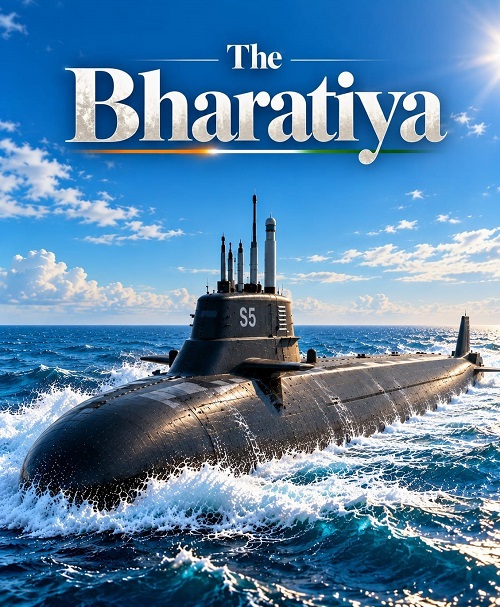
S5 and K6: India’s Roadmap to a Blue-Water Navy
The next frontier of India’s maritime power lies beneath the waves—where strategic deterrence, indigenous submarine development and expanding global ambitions converge. India’s maritime ambitions are entering a consequential phase.
The next chapter of the Indian Navy’s evolution will not be defined by aircraft carriers and surface combatants alone, but by what remains largely invisible beneath the ocean: nuclear-powered ballistic missile submarines, nuclear-powered attack submarines and a new generation of indigenous underwater platforms.
At the centre of this long-term vision stands the proposed S5-class nuclear-powered ballistic missile submarine (SSBN), expected to carry the next generation of India’s submarine-launched ballistic missiles. Alongside the reported K-6 missile programme, the S5 represents an ambition to extend India’s sea-based nuclear deterrent towards intercontinental reach. Meanwhile, the development of nuclear-powered attack submarines and future indigenous conventional designs could provide the endurance and operational flexibility required for a navy with growing responsibilities across multiple maritime theatres.
The direction is clear: India seeks a submarine force capable of protecting its strategic interests, preserving a credible retaliatory capability and supporting a wider blue-water naval presence.
The S5: The future centrepiece of India’s nuclear deterrent
India’s SSBN programme has progressed from the Arihant-class technology demonstrator towards a more mature sea-based nuclear deterrent. INS Arihant and INS Arighaat are established milestones in this journey. Recent defence analysis reports that INS Aridhaman was commissioned in April 2026, although India’s public disclosure practices around its strategic submarine fleet remain limited. [1][2]
The proposed S5-class is expected to represent a substantial step beyond the existing boats, with greater displacement, a more powerful reactor and capacity for a larger missile load. Defence reporting has associated the programme with the K-6, a missile reported to have a potential range of approximately 10,000–12,000 kilometres. However, neither that range nor the complete S5 configuration should be treated as a publicly verified operational capability. Open-source reporting on the K-6 remains limited, and programme details are not officially disclosed in full. [1][3]
The strategic logic is significant. A submarine carrying long-range ballistic missiles can remain concealed at sea while retaining the ability to deliver a retaliatory strike. Greater missile range could allow India to patrol farther from hostile coastlines without sacrificing the ability to hold distant targets at risk.
This is the essence of a survivable second-strike capability: an adversary cannot assume that a first strike would eliminate India’s capacity to retaliate. The S5, therefore, is not simply another submarine. It is a prospective cornerstone of India’s long-term nuclear deterrence architecture.
Two S5 submarines—and the strategic value of numbers
Reporting in 2026 has described two S5-class submarines as being under construction or planned, though the full official programme schedule and force structure have not been publicly detailed. If followed by additional boats, the programme could help sustain a more resilient at-sea deterrent as earlier SSBNs enter maintenance, refit and eventual retirement cycles. [2]
The key advantage would not simply be the number of submarines, but the availability of operational boats. A submarine undergoing maintenance cannot provide the same at-sea deterrent as one on patrol. Crew training, maintenance infrastructure, secure communications and missile readiness are therefore as important as the platforms themselves.
India’s undersea nuclear posture must also be understood within the framework of its declared doctrine of credible minimum deterrence and nuclear retaliation. The objective is not to accumulate submarines for their own sake; it is to ensure that India’s nuclear deterrent remains survivable under the most demanding circumstances. [2][4]
Project 77 and Project 76: The attack-submarine equation
A blue-water navy requires more than strategic missile submarines. SSBNs provide a nuclear retaliatory capability, while attack submarines are designed primarily for conventional naval warfare: tracking and countering hostile submarines, threatening surface combatants and supporting maritime operations.
India’s indigenous nuclear-powered attack-submarine programme, commonly associated with Project 77, is therefore important. In 2024, the government approved construction of two indigenous SSNs. Defence reporting places the first boat’s expected delivery in the 2036–37 period, although schedules remain subject to design, construction and testing. The longer-term ambition is often described as a six-boat programme, but the initial sanctioned construction phase is for two submarines. [4][5]
Nuclear propulsion offers sustained underwater endurance and high submerged speed without the need for frequent conventional battery charging or snorkeling. These characteristics can be valuable for operations across distant maritime theatres. They do not, however, automatically make a nuclear submarine quieter than every conventional submarine: acoustic performance depends on design, machinery, operating conditions and the generation of the platform.
Project 76 represents a complementary ambition: an indigenous conventional submarine design. Current reporting describes a programme centred on an initial six boats, with design work progressing; this should not be confused with a confirmed order for twelve. A longer-term fleet aspiration of 30 indigenous nuclear-powered attack submarines is likewise not an established procurement commitment. Project 76 and Project 77 are different programmes with different propulsion systems and missions. [5][6]
The strategic objective should be to build a balanced force in which conventional submarines cover important regional missions, SSNs provide long-range underwater reach and SSBNs maintain the sea-based nuclear deterrent.
From S1 to S5: A generational transition
India’s indigenous SSBN programme is frequently discussed through the designations S1, S2, S3, S4 and S4, followed by the planned S5 generation. The designations require care: S1 is associated with the earlier technology demonstrator; INS Arihant is commonly identified as S2; INS Arighaat as S3; and the subsequent boats are associated in defence reporting with S4 and S4. S5 represents the planned larger successor class. These labels are not all equivalent to officially announced service names or publicly confirmed operational milestones. [2][3]
The significance of this progression lies in accumulated industrial and technological expertise. Designing nuclear-powered submarines requires mastery of reactor engineering, hull construction, acoustic treatment, combat systems, underwater communications and stringent safety processes.
Successive generations can build upon this knowledge. But the transition from a working prototype to a dependable fleet requires repeatable production, trained crews, reliable maintenance and a domestic industrial supply chain capable of supporting platforms over decades.
India’s ambition to reduce dependence on foreign submarine designs is therefore as much an industrial undertaking as a military one.
The Arctic: A changing maritime frontier
The strategic geography of the oceans is also changing. Rising temperatures and declining seasonal sea ice have increased the navigability of some Arctic shipping routes, creating new commercial opportunities and intensifying geopolitical competition.
For India, the Northern Sea Route could offer an alternative connection between parts of Asia and Europe. It could also influence future energy logistics, access to resources and the maritime calculations of Russia, China and other Arctic stakeholders. Yet the route is not an unrestricted corridor: seasonal ice, extreme weather, environmental risks, infrastructure limitations and the sovereignty of Arctic states will continue to constrain operations.
For India, the immediate requirement is not simply to project naval power into the Arctic. It is to develop a more comprehensive understanding of polar maritime developments, strengthen diplomatic and scientific engagement, and assess how changing shipping patterns could affect its economic and security interests.
Nuclear-powered submarines may offer endurance advantages in demanding environments, but a sustained Arctic presence would require specialised training, suitable equipment, logistics and careful consideration of international law and environmental responsibilities. The Arctic should therefore be treated as a long-term strategic consideration—not as an inevitable extension of routine Indian Navy deployments.
Strategic chess pieces across the global maritime map
The submarine’s greatest strategic value often comes from uncertainty. An adversary may know that a submarine is deployed without knowing its exact location, mission or future movements. That uncertainty complicates naval planning and can strengthen deterrence.
India’s maritime interests already extend beyond the immediate coastline. The Indian Ocean carries major energy shipments and commercial traffic, while the approaches to the Strait of Hormuz, Bab-el-Mandeb and the Strait of Malacca influence the movement of goods between continents.
A more capable undersea fleet could contribute to India’s ability to monitor maritime developments, protect its interests and respond to emerging threats. It would complement surface fleets, maritime patrol aircraft, space-based surveillance and partnerships with other navies.
However, submarine numbers alone cannot establish persistent global presence. That requires trained personnel, dependable maintenance, intelligence and surveillance networks, secure communications, replenishment arrangements and the ability to sustain deployments far from home ports.
Nor can a single submarine class perform every mission. Strategic missile submarines must preserve their deterrent role, while attack submarines and conventional boats fulfil different operational requirements. The objective is an integrated maritime force, not simply a larger collection of underwater platforms.
The real test: Turning ambition into capability
India’s naval roadmap faces several challenges:
• Industrial capacity: Nuclear submarine construction demands specialised facilities, highly skilled workers and dependable suppliers.
• Technological maturity: Reactor reliability, quiet propulsion, sonar performance and combat-system integration require extensive testing.
• Procurement timelines: Delays in conventional submarine programmes can create gaps while older boats approach retirement.
• Fleet sustainability: Crew training, maintenance cycles and infrastructure determine how many submarines can be kept operational.
• Strategic balance: Investment in submarines must be matched by anti-submarine warfare, maritime surveillance and the surface fleet.
The government’s wider emphasis on indigenous naval construction provides an industrial foundation for this effort. Official Ministry of Defence material has highlighted indigenous submarine construction, localised subsystem development and the expansion of domestic shipbuilding. But the measure of success will not be the number of programmes announced. It will be the number of capable platforms delivered, maintained and available when required.
Conclusion: India’s blue-water future will be shaped beneath the waves
The S5-class SSBN and the reported K-6 missile programme represent an ambitious future for India’s sea-based nuclear deterrent. Project 77 could provide the endurance and reach associated with nuclear-powered attack submarines, while Project 76 offers a pathway towards greater independence in conventional submarine design. Together, these programmes could help India build a more balanced undersea force—one that supports nuclear deterrence, maritime security and a broader role in the Indo-Pacific.
Yet the transition from aspiration to capability will depend on execution. Long-range missiles must become reliable operational systems, submarine construction must proceed at a sustainable pace, and indigenous technologies must be supported by the infrastructure required for decades of service.
As climate change alters the navigability of the Arctic and strategic competition intensifies across the world’s oceans, India’s maritime interests will continue to evolve. The answer is not to assume that every ocean must become a permanent deployment zone, but to ensure that India has the capabilities, partnerships and strategic awareness to protect its interests wherever they are threatened.
The future of India’s blue-water navy will not be measured only by the warships visible on the horizon. It will also be measured by the strength, endurance and survivability of the force beneath the waves.
SOURCE NOTES & EDITORIAL QUALIFICATIONS
[1] Bulletin of the Atomic Scientists, “Indian nuclear weapons, 2026” (2026): open-source assessment of S5, K-5/K-6 reporting and the limits of publicly available programme information.
[2] International Institute for Strategic Studies (IISS), “Deepening deterrence: India’s expanding SSBN capability” (May 2026): SSBN fleet, S4*, S5 and deterrence posture.
[3] Carnegie India, “The Coming of Age of India’s Nuclear Triad” (April 2026): Arihant-class development, missile-range context and S5 outlook.
[4] DRDO / Ministry of Defence reporting on INS Arighaat and Project 77, including the 2024 approval for two indigenous nuclear-powered attack submarines.
[5] India Today, “India’s twin submarine dilemma” (20 May 2026): Project 76 and Project 77 programme context and reported timelines.
[6] Naval News, “Indian Navy’s indigenous submarine programs gather steam” (September 2025): Project 76/77 status and broader submarine programme context.
[7] Press Information Bureau, Ministry of Defence, “India’s submarine capability…” (2025): official overview of indigenous submarine programmes and localisation.
Editorial note: This article distinguishes publicly established programmes from reported capabilities and long-term projections. The K-6’s frequently reported 10,000–12,000 km range, the precise S5 fleet size and a 30-boat indigenous SSN fleet should not be treated as confirmed operational capabilities or approved procurement commitments without further official confirmation.