
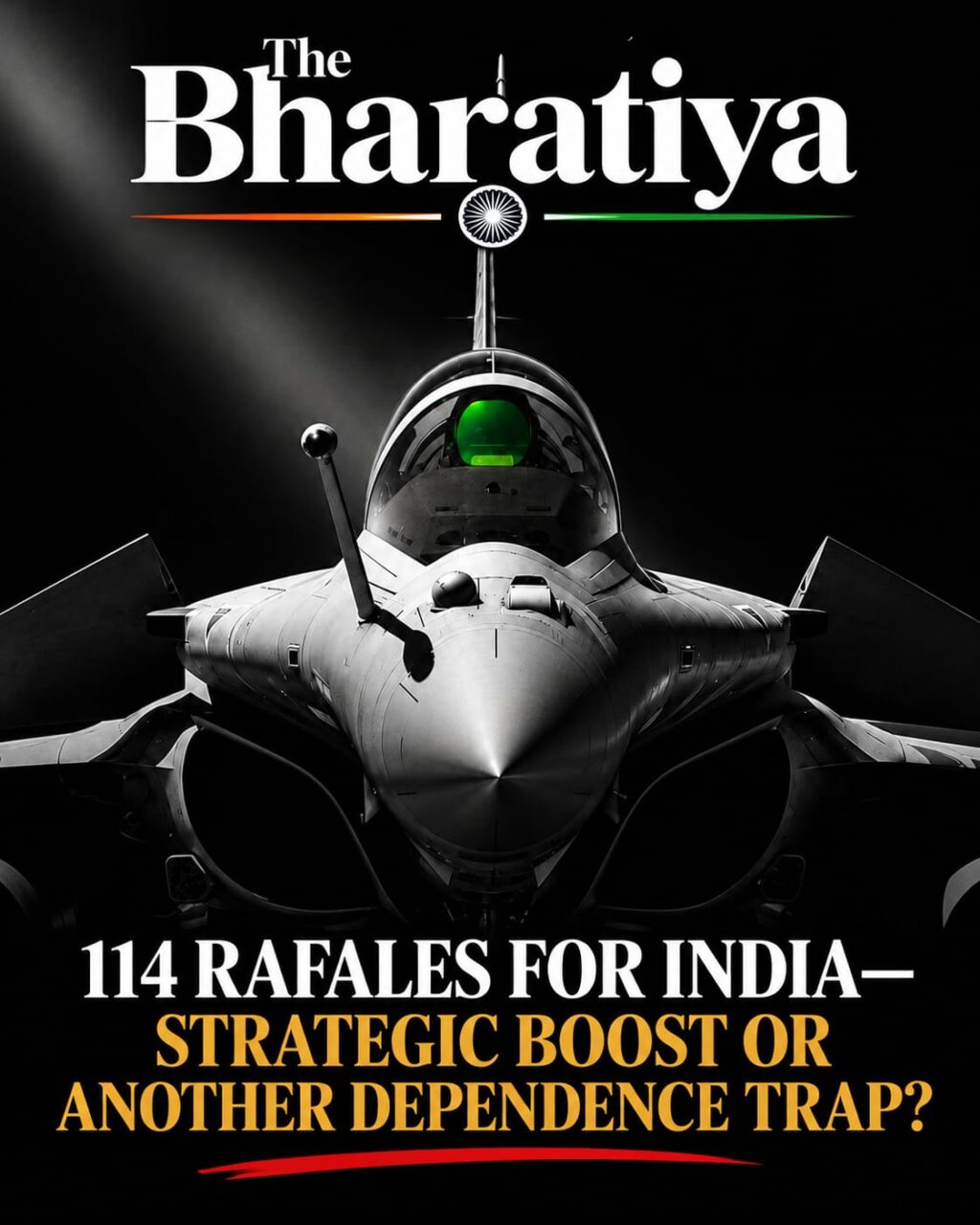
114 Rafales for India: A Hefty Bill, Too Many Red Tapes and the Price of Strategic Dependence?
Is India’s proposed acquisition of 114 Rafale fighters a strategic necessity, or another expensive compromise in its pursuit of military modernisation?
“A country that does not make its own weapons cannot have an independent foreign policy.” — Charles de Gaulle
The philosophy behind France’s Force de Frappe was rooted in a fundamental principle: strategic autonomy is impossible without control over the instruments of national power. For France, an independent nuclear deterrent was not merely a military capability; it was an assertion of sovereignty.
Decades later, this philosophy raises an uncomfortable question for India: can New Delhi truly pursue strategic autonomy while remaining dependent on foreign manufacturers for some of its most sophisticated military capabilities?
The proposed acquisition of 114 additional Rafale fighters, potentially amounting to one of India’s largest defence procurement exercises, brings this paradox into sharp focus.
At an estimated price of approximately ₹2,800 crore per aircraft, the question is no longer simply whether the Rafale is an excellent fighter. It undoubtedly is a formidable 4.5-generation combat aircraft. The real question is whether the price, industrial conditions, technological restrictions and long-term dependencies justify the investment.
Is India buying an aircraft, or signing up for another generation of strategic dependencies?
1.The M88 engine: Where does technology transfer actually stop?
One of the most important aspects of the proposed arrangement concerns the Rafale’s M88 engine.
Reports of France safeguarding critical engine technologies, while exploring possibilities for local assembly in India, deserve serious attention.
Local assembly is not equivalent to technological ownership.
If critical components, specialised manufacturing processes and sensitive technologies remain under French control, India could find itself assembling an engine without acquiring the industrial capabilities required to independently manufacture, maintain and eventually develop its successor.
This is precisely where the distinction between Make in India and genuine technological self-reliance becomes important.
India must avoid repeating the familiar pattern of acquiring sophisticated foreign platforms while remaining dependent on overseas suppliers for critical components, upgrades and lifecycle support.
A fighter assembled in India is not necessarily an Indian-controlled fighter.
And at ₹2,800 crore per aircraft, India has every right to demand more than assembly-line participation.
2.The Mirage mistake: Is India repeating history?
India’s experience with the Mirage 2000 demonstrated the importance of maintaining a capable, reliable and well-supported combat fleet.
The IAF’s inventory has evolved through decades of acquisitions from different countries. Today, its operational ecosystem includes Indian, Russian and French-origin platforms, alongside aircraft incorporating Western technologies.
This diversity offers operational flexibility, but it also creates a complicated logistical environment.
Different engines, maintenance philosophies, spare-parts supply chains, weapons integration requirements and training systems make fleet management an expensive exercise.
A larger Rafale fleet could offer an important degree of standardisation, particularly as the IAF continues to operate its existing Rafales.
On paper, consolidating around a proven platform makes considerable sense.
But there is a contradiction.
India could spend hundreds of billions of rupees building a larger French-origin fighter fleet while continuing to depend on France for critical technologies, upgrades and industrial support.
Logistical simplicity is valuable. Technological independence is indispensable.
India needs both, not one at the expense of the other.
3.The growing heads of the dragon and India’s shrinking squadron strength
The urgency behind the procurement cannot be dismissed.
The IAF continues to confront the challenge of declining fighter squadron strength, ageing legacy aircraft and delayed indigenous programmes.
Across the Himalayas, China is rapidly expanding and modernising its airpower.
The People’s Liberation Army Air Force is fielding substantial numbers of fifth-generation J-20 fighters, alongside a growing ecosystem of advanced aircraft, long-range missiles, airborne surveillance systems and network-centric warfare capabilities.
The scale of China’s fifth-generation ambitions presents a serious challenge for India’s military planners.
But the challenge extends beyond aircraft inventories.
Chinese military activities along the Line of Actual Control, combined with the growing sophistication of the PLA Air Force, continue to test India’s strategic patience and military preparedness.
The question New Delhi must confront is uncomfortable but unavoidable:
Will India depend on Beijing’s mercy, or will it develop the military strength and technological independence necessary to defend its own interests?
In an increasingly competitive Asian security environment, strategic autonomy cannot rest on diplomatic assurances alone. It requires credible deterrence, industrial capacity, technological innovation and the ability to sustain military operations without excessive dependence on external suppliers.
India, meanwhile, faces a difficult choice: acquire proven foreign platforms to address immediate operational requirements or continue waiting for indigenous programmes to mature.
The danger lies in allowing short-term procurement requirements to dictate long-term strategic dependence.
China is not waiting for India’s aerospace industry to catch up. Its aircraft manufacturing ecosystem continues to evolve, and its ability to manufacture and integrate advanced combat platforms at scale is an important strategic consideration.
India cannot afford to treat military modernisation as an exercise in procurement alone.
It must become an exercise in building national power.
4.The Rafale F5 question: Are we paying for tomorrow’s technology today?
Another important consideration is the future evolution of the Rafale.
The F5 standard is expected to introduce significant improvements in combat capabilities, sensor integration, weapons compatibility and connectivity with unmanned systems.
However, India must carefully distinguish between acquiring today’s operational capability and financing technological developments that may primarily benefit the future requirements of France and other Rafale operators.
If India is paying a substantial premium, it must secure a clearly defined roadmap for upgrades, technology access, weapons integration and industrial participation.
The question is straightforward:
Why should India commit enormous financial resources to a platform whose most advanced technological iterations may remain outside its direct control?
A procurement agreement must not become a blank cheque for future upgrades.
5.AMCA and Tejas: India cannot win today’s war with tomorrow’s weapons
The Advanced Medium Combat Aircraft (AMCA) represents India’s ambition to move beyond licensed production and become a genuine designer and manufacturer of advanced combat aircraft.
But ambition without execution is little more than a presentation slide.
With AMCA development timelines facing considerable pressure, India’s indigenous fifth-generation fighter ambitions remain a long-term proposition.
The AMCA is strategically important, but it cannot solve an immediate squadron-strength crisis.
And the problem does not end with the AMCA.
India’s indigenous Tejas programme, which was supposed to become the backbone of the IAF’s light combat aircraft fleet, has also faced production and delivery pressures associated with delays in the supply of GE F404 engines from the United States.
This presents an uncomfortable reality for New Delhi: even a domestically designed fighter can remain vulnerable to disruptions in foreign engine supply chains.
India cannot claim complete strategic autonomy when the production tempo of its own combat aircraft depends on the delivery schedules and export arrangements of another country.
India cannot win today’s war with tomorrow’s weapons.
The IAF needs operationally available fighters today, not merely ambitious programmes scheduled to deliver advanced capabilities years into the future.
But there is an equally dangerous contradiction.
If India continues purchasing foreign fighters to compensate for delays in indigenous programmes, it risks creating a cycle in which domestic aerospace development never receives the industrial scale, investment and technological urgency it requires.
The country could end up paying for foreign aircraft today while postponing the development of its own technological capabilities tomorrow.
India needs a credible bridge between immediate operational requirements and long-term indigenous development.
And that bridge cannot simply be another multibillion-dollar foreign procurement.
6.What about the Russian Su-57?
Perhaps the most interesting question is whether India has adequately examined every available option.
Russia’s Su-57 represents another potential pathway towards acquiring fifth-generation combat aviation capabilities.
It would be premature to declare it a better alternative to the Rafale or AMCA without examining its operational maturity, production capacity, engine technology, maintenance requirements, weapons integration and technology-transfer conditions.
However, dismissing the possibility without a comprehensive comparative assessment would be equally short-sighted.
India should evaluate the Su-57 against the Rafale and its future upgrades, AMCA and other available pathways through a transparent assessment of capability, cost, industrial participation and strategic dependence.
The objective should not be to replace French dependence with Russian dependence.
It should be to ensure that India has the strongest possible negotiating position.
7.The final question: How much is strategic autonomy worth?
India is approaching a defining moment in its military modernisation.
The Rafale is a capable aircraft. The IAF needs additional fighters. China’s growing airpower cannot be ignored, and the AMCA cannot be expected to materialise overnight.
But necessity should never become an excuse for abandoning industrial ambition.
A procurement worth hundreds of thousands of crores must deliver more than aircraft numbers. It must strengthen India’s aerospace ecosystem, expand domestic manufacturing capabilities, improve indigenous engine development and reduce long-term dependence on foreign suppliers.
The objective should be to purchase capability today without mortgaging technological independence tomorrow.
As China expands its fifth-generation fleet and continues to strengthen its military-industrial ecosystem, India’s margin for strategic complacency is shrinking.
India must recognise that its strategic future cannot depend on the goodwill of Beijing, the technology-transfer policies of Paris or the geopolitical calculations of Moscow and Washington.
The Tejas engine supply issue is a reminder that even India’s indigenous programmes can be exposed to foreign supply-chain vulnerabilities. The proposed Rafale acquisition, with its own questions surrounding technology transfer and engine manufacturing, could add another layer to this dependence.
India’s strategic autonomy is increasingly becoming a gamble on the goodwill and political calculations of foreign nations.
And that is precisely the paradox New Delhi must resolve.
The balance of power in Asia will not be determined by who signs the biggest defence contract.
It will be determined by who can design, manufacture, maintain and continuously upgrade the weapons that defend their national interests.
The country with the bigger stick may command the room. But the country that manufactures its own stick decides how long it can keep swinging.
And as Chinese troops and aircraft continue to test India’s patience along its borders, one question becomes increasingly important:
Will India depend on Beijing’s mercy, or stand on the strength of its own will?
For India, the Rafale deal must answer one fundamental question:
Are we buying strategic superiority, or simply purchasing time at an increasingly expensive price?
— Jeet Ghosh
Geopolitical analyst